An occult magazine editor spent years chasing the kunekune—until the day he finally saw it.
—You wish to hear it, then.
So be it… but keep your light close.
Mark was known among his colleagues for being far too serious.
No matter how absurd a rumor sounded, he would travel to the location himself, set up his camera, and look for evidence.
People at the office half-jokingly called him the ghost hunter, but Mark never laughed.
Of all the strange things he’d pursued, there was one that obsessed him most— the kunekune.
A pale, slender figure said to sway in the distance across rice fields or meadows, and those who saw it clearly were doomed to lose their minds.
It was a story born from Japan’s early internet age, around the 2000s.
For more than ten years, Mark had been chasing proof of its existence.
One summer, he returned to Japan once more.
His destination was a small rural village in the Tōhoku region,
where an old message board post had mentioned seeing “a white figure moving in the fields.”
When he arrived, the village was wrapped in the sound of cicadas.
Green rice paddies shimmered under the sun, and heat rose like waves from the mountains.
He left his luggage at a small inn, and—using the bits of Japanese he had learned along with a translation app— interviewed one of the village elders.
The old man fell silent for a long while before muttering,
“…It is a curse given shape by the wind.”
“You must not look upon the god of the fields,” he continued.
“If you see it, what you truly see is not a god at all, but a formless swaying thing. That is the kunekune.”
Mark tilted his head.
“So it’s… a god? Not a ghost?”
The old man did not answer.
He simply shook his head slowly.
“Do not look. If you do… you will never come back.”
The next morning, Mark left his inn at dawn.
He carried his camera, a tripod, and a drone.
Somewhere beyond the waves of rice, something was waiting for him.
The sun climbed higher.
And there—amid the golden light—something white moved.
At first, it looked like a scrap of cloth caught on a pole.
But there was no wind.
The air grew heavy, and even the sound of the cicadas seemed to fade away.
Mark held his breath.
He zoomed in.
On the screen, it turned slowly toward him.
It had arms—of a sort—but no joints.
Its body rippled like water, unable to keep its shape,
and yet it moved closer, twisting and undulating.
“Let me film you…” he whispered, pressing the shutter.
For an instant, the camera flickered with static.
And then—all sound disappeared.
No wind. No insects. Nothing.
In that unnatural silence… Mark smiled.
A few days later, he returned home.
At his desk, he began reviewing the footage.
There it was—something white swaying across the rice fields.
Blurry, indistinct, yet undeniably moving.
He nodded in satisfaction.
But when he paused the video, something felt off.
Each time he froze the frame, the shape of the figure was slightly different.
Each time he replayed it, it seemed a little closer than before.
That night, the glow of his monitor filled the room.
Outside, the power lines trembled—
though the air was perfectly still.
Without realizing it, Mark traced the surface of his desk with his fingers,
mimicking the soft, rippling motion of the rice.
A few days later, a colleague came to check on him.
The room was dark. The curtains were drawn.
Only the light of the computer remained.
The shape of a man.
Of Mark.
“Mark!” his colleague shouted.
At that moment, the figure on the screen turned its head— and smiled.
The air in the room twisted.
Sound and light were swallowed by that same swaying motion—
and then, everything went dark.
Weeks passed after Mark’s disappearance.
His colleague noticed strange posts appearing on social media.
People claiming to have seen “a white mist moving at night,”
or “a swaying shape caught in a riverside photo.”
Most dismissed them as cheap visual effects,
and the posts never went viral.
But one thing caught the colleague’s eye—
the locations of the sightings were changing.
Each report was a little farther from the last.
It was… moving.
He began tracing the pattern.
And then, one day, he too stopped replying to messages.
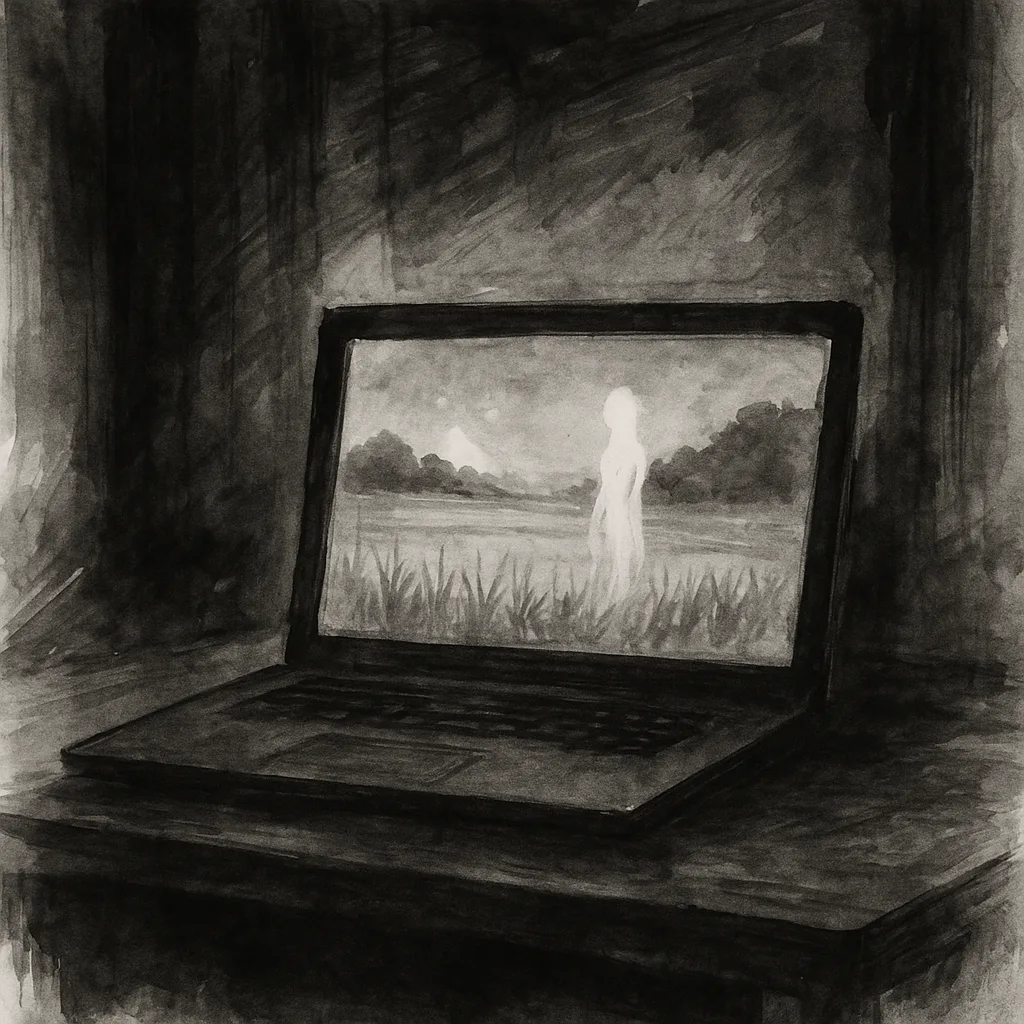
When people entered his apartment, they found an open laptop on the desk.
On the screen was a view of a rural field somewhere.
And beside it lay a small note.
“Is he trying to come home?” it read.
In the early 2000s, the kunekune terrified Japan’s internet community.
Now, thanks to one curious editor,
perhaps it has left those rice fields behind—
and begun wandering the wider world.
So if you ever see something swaying in the distance,
don’t stop to look.
Don’t try to see if it’s the wind.
Because by now…
it may have already left Japan’s fields behind.
Leave the light on, if you can.
Shadows linger after stories like this.
We will meet again… when you are ready to hear another.
Heh… heh…